
 |
 |
 |
 |
 |
 |
 |
 |
 |
 |
 |
|

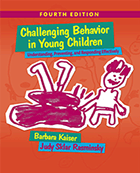
Sixteen reasons to buy Challenging Behavior in Young Children, Edition 4
1. Practical and realistic. This book has a frontline perspective rarely found in textbooks. The problems described are real problems, and examples featuring real children in real classrooms make the information and strategies come alive.
2. User-friendly. Besides being fun to read, this book is well organized, logical, and academically rigorous. The writing is clear and concise; numerous text boxes and videos add spice and illuminate specific points.
3. Comprehensive. The text brings together knowledge from neuroscience, psychology, psychiatry, child development, special education, early care and education, cross cultural research, and proactive social and emotional skills programs and organizes it into a single comprehensive (and comprehensible) whole. The research-based strategies can be used separately or together, providing students and teachers with a collection of tools appropriate for many different children and situations.
4. Culturally sensitive. In an entire chapter dedicated to the vital role of culture in children’s lives, the text examines the influence of culture on teaching and behavior and includes sections on culturally responsive teaching and dual-language learning. Snapshots of the country’s largest minority groups point out important cultural values that may lead to behavior being misperceived as challenging.
5. The brain. The mystery of behavior and the brain gets a whole chapter, revised to include the most recent research. It emphasizes the effects of toxic stress on the brain and behavior and explains how toxic stress influences executive function. The chapter also examines how genes can modify behavior.
6. Relationships. No strategy works in a vacuum. Relationships are critical to good teaching, especially to teaching children with challenging behavior, and they provide the best protection against risk. Chapter 5 is devoted to the art of building relationships with children and families and includes explanations of attachment theory and what makes relationships work.
7. Self-reflection. Self-knowledge and self-reflection enable teachers to see children more clearly and to stay cool in difficult situations. A special section on self-reflection helps students and teachers to deal with challenging behavior by getting to know themselves and examining their own teaching practice.
8. Strategies for preventing challenging behavior. Two full chapters explain how to prevent challenging behavior through the use of an inclusive social climate, physical environment, routines and transitions, curriculum, and teaching strategies that promote and teach appropriate behavior and social and emotional skills.
9. Strategies for responding to challenging behavior. The book is loaded with strategies for reacting to challenging behavior. There is a balanced overview of positive reinforcement, natural and logical consequences, time-out, and time-away; and explanations of the guidance techniques of developmental discipline, teacher effectiveness training, and collaborative problem-solving. There is also a detailed section on what to do when a child loses control.
10. Functional assessment (FA) and positive behavior support (PBS). A whole chapter is devoted to these two connected strategies, which view problem behavior from the child’s perspective. The chapter provides an easily understandable explanation of “triggers,” “antecedents,” “setting events,” and “consequences” and how they work together to create behavior that enables a child to get what he or she wants. Students and teachers will learn how to identify the purpose of the behavior and to develop a behavior plan that prevents and responds effectively to challenging behavior.
11. Resilience. This chapter describes new research on resilience and describes how to strengthen the protective factors that enable children to overcome the risk factors in their lives. Sensitive, responsive caregiving, whether by families or teachers, is key. The chapter also describes the important influence of a secure and predictable environment, culture, context, genes, grit, and mindset.
12. Inclusion. IDEA legislates inclusion as the norm, giving all children, regardless of abilities, the right to participate actively in the regular schools and child care centers they would attend if they were developing typically. The chapter on inclusion explains the role of disability in challenging behavior and helps students and teachers to prevent and minimize this behavior by creating an inclusive social climate; building strong relationships with children, families, and colleagues; teaching social and emotional skills; and implementing IEPs.
13. Bullying. An entire chapter on bullying—containing more information than any other book on challenging behavior—describes what’s known about children who bully, children who are targeted, and bystanders, and suggests ways to prevent and respond to bullying. This edition emphasizes the importance of new research on social climate and describes what to do in a bullying situation. There are also useful tips for working with parents of children involved in bullying.
14. Risk factors for challenging behavior. The biological and environmental risk factors, thoroughly researched and up to date, are all explained here—temperament, substance abuse during pregnancy, language and cognitive disorders, executive function, the violent media, poverty, peers, and more.
15. Family-friendly. It’s hard to underestimate the importance of teacher-family partnerships. This book helps students and teachers to understand and communicate with families, even when they’re saying things people don’t want to hear.
16. Questions for discussion. A section called “What do you think?” at the end of each chapter poses questions to encourage students think about the material and make it their own. A new section, “What do you know?” which is aligned with the learning objectives at the beginning of each chapter, focuses on basic information. Along with several new reflective checklists, these questions help students to apply and assess their own learning.
